
Product · Features
Eight Features That Define the PTW-1900
What we engineered, why we engineered it, and how it compares operationally to U.S.-manufactured industrial benchmarks.
1. Meaningful TCO savings versus U.S. industrial benchmarks
A V-TAI PTW-1900 ships FOB Shenzhen starting from approximately USD $49K for the standard configuration; full pricing depends on chamber dimensions, ATS automation, voltage, and certifications. Like-for-like configuration delivers 30–40% TCO savings versus the equivalent U.S.-manufactured industrial benchmark in the same capacity class. Same throughput. Same sanitization spec. Same engineering rigor.
The price difference comes from V-TAI's Smart Localization methodology — 92% vertically-controlled supply chain with French Schneider Electric controls + Pearl River Delta localized component sourcing. This is not cheap labour arbitrage; it's an engineered cost structure built on digitized workflows and EU-grade engineering rigor applied in China's agile manufacturing infrastructure. We document a 25% material waste reduction and 30% faster production turnaround vs traditional rack-washer manufacturing.
Operational implication: Capital budget for two PTW-1900s typically costs less than one U.S.-manufactured industrial benchmark machine in this capacity class. Plants that would otherwise buy single-machine capacity can buy parallel redundancy.
2. Customizable rack dimensions
Standard chamber: 750 × 1000 × 1900 mm. Customizable to width 700–900 mm × depth 900–1200 mm × height 1700–2100 mm. The chamber is engineered around your trolley, not the other way around.
Most U.S.-manufactured benchmarks in this category ship fixed-dimension chambers. Plants with non-standard trolleys (custom bakery rack widths, oversize airline catering ULDs, hospital meal-cart variants) buy the closest-fit standard chamber and accept inefficient loading. V-TAI engineers chamber dimensions in the CAD review stage; +4 weeks lead time, no premium pricing.
Operational implication: No need to replace your trolley fleet to fit the washer. The washer fits your fleet.
3. Roll-in loading eliminates manual handling
The double-leaf hinged doors open the full chamber width. Floor is flush with the loading apron (pit install) or accessed via a 1:8 ramp. Trolleys roll in on their own wheels. No lifting, no manual transfer.
The hidden cost of conventional dishwashing is musculoskeletal injury. Plants running manual transfer of trolleys + dishes log 1–3 workers' comp claims per year per facility from shoulder, back and wrist injuries. The PTW-1900's roll-in design eliminates the lifting motion entirely.
Operational implication: Insurance premium reduction on liability lines. Easier hiring (the job is physically easier). Compliance with EU ergonomic directives and OSHA recommendations.
4. PLC touch-screen control
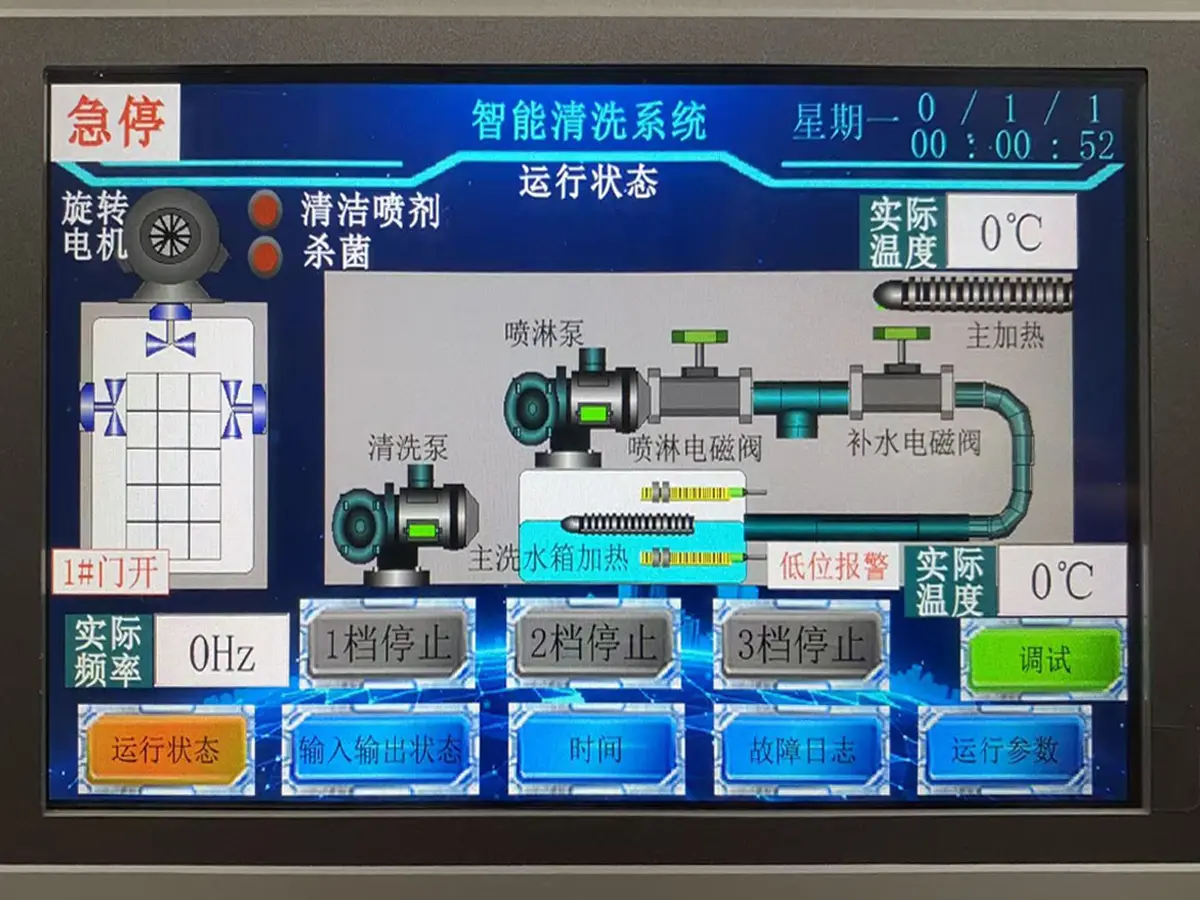
Color touch-screen HMI mounted on the machine front. Operator selects a stored cycle profile (Standard, Heavy, Allergen Reset, Sanitization Only), presses Start. Training time from cold to competent: 30 minutes.
Most U.S.-manufactured benchmark machines in this category use button-panel control as standard, with mechanical timers and analog gauges. Training time on legacy interfaces is 4–8 hours and operator-error rate is measurably higher. The PLC interface also enables CSV cycle logging and Modbus / OPC-UA integration with plant SCADA — the audit chain that legacy button-panel machines cannot produce.
Operational implication: Reduced training burden, reduced operator-error incidents, audit-grade traceability.
5. Dual heating: electric 70 kW OR steam 7 kW
Choose at order time: electric heating (self-contained, no external infrastructure) or steam heating (uses your plant steam loop, drops electrical load to 7 kW). Both versions achieve identical cleaning and sanitization performance.
Why it matters: plants without steam infrastructure (commissaries, schools, hotels, supermarkets) need electric. Plants with steam loops (food processors, dairies, breweries, hospitals, large bakeries) save 60–70% operating cost with steam version. The PTW-1900 is the same machine — only the heating module changes.
Operational implication: Right-size operating cost to your existing utility infrastructure. Don't pay for electric heating when steam is already available.
6. CE / ISO 9001 / China Food Safety — designed to NSF/ANSI 3
The PTW-1900 is engineered for the global export markets. The certifications we actually hold: CE marking under the EU Low Voltage Directive (2014/35/EU) and Machinery Directive (2006/42/EC); ISO 9001:2015 quality management system; and PRC GB 4806-series Food Safety Certification covering SUS304 food-contact materials. All three are held under our manufacturing subsidiary Zhaoqing Hongxiang Machinery Co., Ltd.
Engineering standards we design to: NSF/ANSI 3 thermal sanitization specification (82°C / 180°F final rinse documented per cycle); FDA-compliant materials and gaskets per 21 CFR 177. Honest disclosure: the PTW-1900 is not NSF-listed and we don't claim NSF certification — we design to the technical standard rather than carry the listing. If your project requires NSF listing specifically, we'll tell you upfront.
Operational implication: Pre-cleared for EU CE-marking import and ISO-9001-certified supplier audit frameworks. NSF/ANSI 3 engineering compliance for North American food-service installation. See the certifications page for full PDFs.
7. Heat recovery system
Optional heat-recovery exchanger captures exhaust steam and uses it to preheat incoming cold water. Incoming water rises from ~15°C to ~45°C before reaching the booster tank. The booster's reheat job shrinks; energy consumption drops ~15%.
Payback economics: ~$2,800 add-on cost vs ~$8,000–$13,000 annual energy saving at typical industrial volume. Three-month payback for plants running 60,000+ cycles/year, twelve-month payback for smaller operations.
Operational implication: ESG / sustainability metrics improve. Operating cost drops. Carbon footprint reduces measurably.
8. Adjustable cycle time
PLC stores multiple cycle profiles: Quick 4-min, Standard 6-min, Heavy 9-min, Heavy 12-min, Sanitization Only 8-min, Acid Cycle 6-min. Operator selects per-load. Supervisors can author new profiles for specific soil scenarios.
Why it matters: not every load needs a Heavy cycle. Tuning cycle time to soil severity saves 20–40% of energy and labour-hours over a year of mixed-soil operation. The PTW-1900 is the only machine in its class that exposes cycle-tuning to the operator without sacrificing the audit-traceability of stored profiles.
Operational implication: Match cycle to load. Run shorter cycles on light soils and save real money on energy and throughput.
Ready to Modernize Your Plant's Cleaning?
Get a configuration-specific quote within 12 business hours. Custom rack dimensions, electric or steam heating, full installation specs included.